下面我将为你全面解析六级英语议论文,包括核心特点、写作结构、高分策略、实用模板和真题范文,助你攻克这一题型。
六级议论文核心特点
-
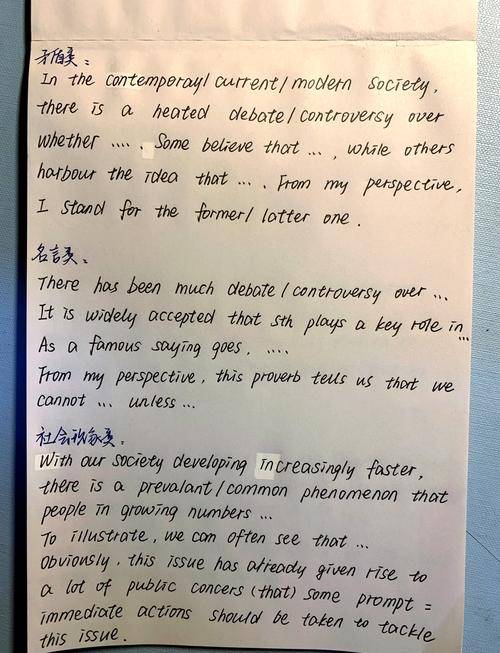
话题深刻,贴近社会:六级议论文话题通常涉及社会热点、文化教育、科技发展、环境保护、个人成长等具有思辨性的议题,它要求考生不仅仅是描述现象,更要分析其背后的原因、影响,并提出自己的观点或解决方案。
 (图片来源网络,侵删)
The impact of social media on interpersonal relationships(社交媒体对人际关系的影响)Should college students be encouraged to start their own businesses?(是否应鼓励大学生创业?)
-
结构严谨,逻辑清晰:议论文的核心在于“论证”,文章必须有清晰的结构,观点明确,论据充分,论证过程有逻辑,常见的结构是“引出话题 - 提出观点 - 论证观点 - 总结升华”。
-
语言正式,表达客观:与书信、通知等应用文体不同,议论文要求使用正式、客观、书面的语言,应避免使用过于口语化的词汇、缩写(如 don't, can't)和过于情绪化的表达。
经典写作结构(“三段论”或“四段论”)
这是最常用且最稳妥的结构,能确保你的文章逻辑清晰,不跑题。
经典四段论结构
第一段:引言段 - 引出话题,明确观点
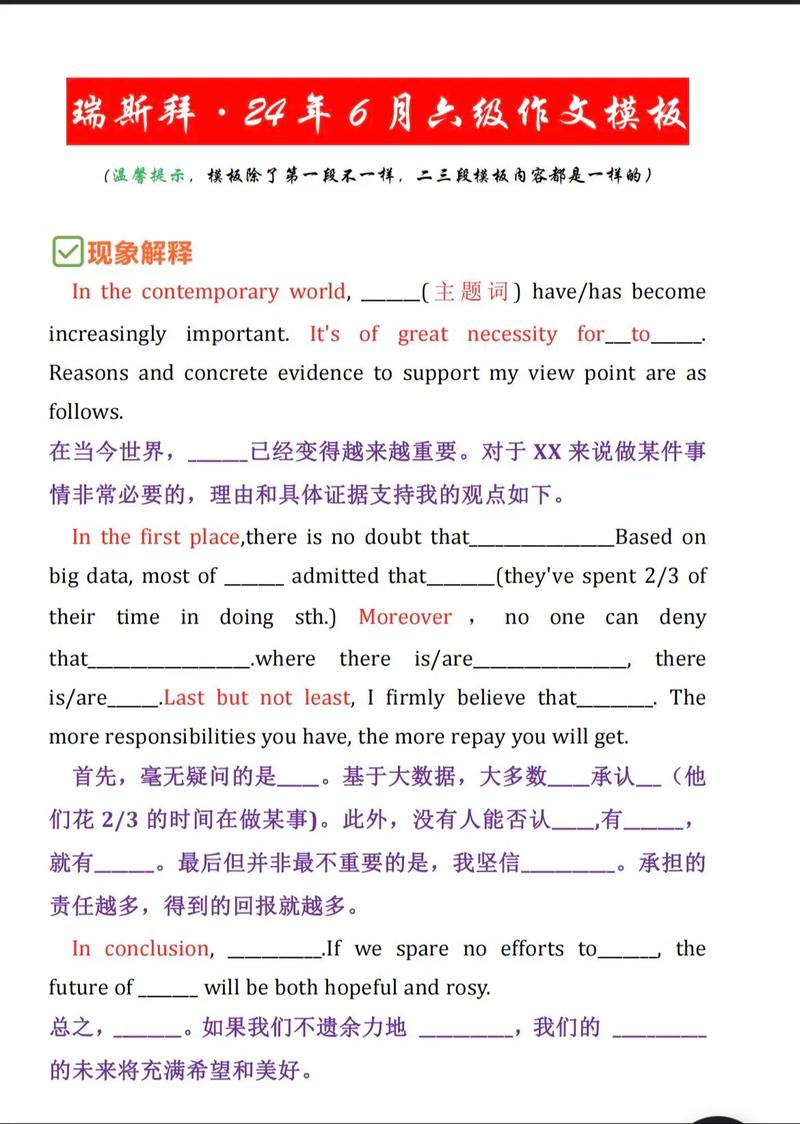
- 功能:描绘背景,引出争议性话题,并清晰表明你的中心论点。
- 写法:
- 背景引入:用一个普遍现象、一句名言、一个数据或一个设问句开头,吸引读者注意力。
- 话题阐述:简要说明该话题的现状或重要性。
- 亮明观点:用明确的转折词(如
However,Nevertheless)引出你的核心论点,这是全文的“灵魂”。
第二段:主体段一 - 论证观点(理由一)
- 功能:从第一个角度支持你的中心论点。
- 写法:
- 主题句:段首句清晰地陈述第一个分论点,这个句子要能概括本段大意。
- 解释论证:对主题句进行解释,说明为什么这个理由能支持你的观点。
- 举例/数据:提供一个具体的例子、个人经历或数据来支撑你的论证,这是让文章“有血有肉”的关键。
- 小结:用一句话重申本论点的重要性,并自然过渡到下一段。
第三段:主体段二 - 论证观点(理由二)
- 功能:从第二个角度(或从反面)进一步支持你的中心论点。
- 写法:
- 主题句:段首句陈述第二个分论点。
- 解释论证:详细阐述。
- 举例/对比:提供另一个例子,或者从反面论证如果不这样做会有什么后果(对比论证)。
- 小结:总结本段,并为结尾段做铺垫。
第四段:结论段 - 总结观点,升华主题
- 功能:重申观点,总结全文,并提出展望或建议。
- 写法:
- 重申观点:用不同的措辞再次强调你的中心论点,切忌简单重复第一段的原话。
- 总结论据:简要回顾第二、三段提出的两个主要理由。
- 升华/展望:提出建议、预测未来、强调意义或发出呼吁,使文章立意更高。
- 收尾:用一句有力的话结束全文。
高分策略与技巧
-
审题精准,观点明确
 (图片来源网络,侵删)
- 仔细阅读题目要求,确保你的文章完全回应了题目的所有指令(如
Do you agree or disagree?,Discuss both views and give your own opinion.)。 - 观点必须清晰、直接,避免模棱两可,选择一个你最有话说的立场。
- 仔细阅读题目要求,确保你的文章完全回应了题目的所有指令(如
-
逻辑连贯,过渡自然
- 使用恰当的连接词来组织段落和句子,使文章脉络清晰。
- 段间过渡:
Firstly, Secondly, Finally, Moreover, Furthermore, In addition, On the other hand, However, Nevertheless... - 句间过渡:
For example, For instance, As a result, Therefore, Consequently, In fact, Specifically...
-
句式多样,词汇丰富
- 句式:不要总是用主谓宾的简单句,交替使用复合句(定语从句、状语从句)、并列句、倒装句、强调句和非谓语动词结构。
- 简单句:
Reading is important. - 复合句:
Reading, which broadens our horizons, is of great significance to our personal growth. - 强调句:
It is through reading that we can acquire knowledge and wisdom.
- 简单句:
- 词汇:使用学术性词汇和同义替换来提升文章档次。
important->significant, crucial, vital, essentialgood->beneficial, advantageous, positivebad->detrimental, harmful, negative, adverse
- 句式:不要总是用主谓宾的简单句,交替使用复合句(定语从句、状语从句)、并列句、倒装句、强调句和非谓语动词结构。
-
论证有力,例证恰当
- 论点不能是空中楼阁,必须有论据支撑,论据可以是:
- 个人经历:真实、具体。
- 普遍现象:大家熟知的社会事实。
- 名人名言:增加权威性。
- 数据报告:最具说服力(如果记得的话)。
- 例子要服务于论点,不要为了举例而举例。
- 论点不能是空中楼阁,必须有论据支撑,论据可以是:
实用模板与句型
第一段(引言)
- 背景引入:
In contemporary society, ... has become a topic of intense debate.(在当今社会,……已成为一个激烈争论的话题。)The issue of whether ... is a controversial one that has sparked a heated discussion.(是否……是一个引发激烈争论的争议性问题。)It is universally acknowledged that ... plays a pivotal role in our daily lives.(众所周知,……在我们的日常生活中扮演着关键角色。)
- 亮明观点:
From my perspective, I am in favor of the idea that ...(在我看来,我赞同……的观点。)As far as I am concerned, the advantages of ... outweigh its disadvantages.(就我而言,……的利大于弊。)However, I firmly believe that ...(我坚信……)
第二、三段(主体)
- 主题句:
The primary reason for my stance is that ...(我持此观点的主要原因在于……)Another contributing factor is that ...(另一个 contributing 因素是……)In addition, ... also brings about significant benefits.(……也带来了显著的好处。)
- 举例论证:
A case in point is that ...(一个恰当的例子是……)To illustrate, let's take ... as an example.(为了说明,让我们以……为例。)This can be best exemplified by the fact that ...(这可以由……的事实得到最好的证明。)
第四段(
- 重申观点:
In conclusion, reiterating my point, ...(重申我的观点,……)To sum up, while ... has its merits, I still contend that ...(尽管……有其优点,但我仍然认为……)
- 升华/展望:
It is high time that we attached greater importance to ...(我们是时候更加重视……了)Only by doing so can we ...(只有这样我们才能……)Looking ahead, it is imperative for us to ...(展望未来,我们必须……)
真题范文示例
** Some people believe that university education should be free for everyone. To what extent do you agree or disagree?
范文分析:
- 立场:部分同意,大学教育不应完全免费,但政府应提供更多支持。
- 结构:四段论。
- 第一段:引出“免费大学教育”话题,表明部分同意的立场。
- 第二段:从“促进教育公平和社会流动性”角度,支持免费教育的观点。
- 第三段:从“财政负担”和“教育质量与价值”角度,反对完全免费,并提出折中方案。
- 第四段:总结观点,强调政府、个人和社会的共同责任。
范文:
Should University Education Be Free for Everyone?
In an era where knowledge is increasingly recognized as the primary driver of economic and social progress, the question of whether university education should be accessible to all at no cost has become a prominent topic of discussion. While the ideal of free tuition for everyone is appealing, I believe that a more nuanced approach is required, as completely free university education may not be the most viable solution for all parties involved.
On the one hand, the argument for free university education is compelling. Proponents rightly highlight its potential to democratize education, breaking down the financial barriers that prevent talented but underprivileged students from pursuing higher learning. This, in turn, could foster greater social mobility and cultivate a more skilled and innovative workforce, which is essential for a nation's long-term competitiveness. For instance, in countries like Germany, where public universities charge no tuition, students from diverse socioeconomic backgrounds have equal opportunities to access higher education, leading to a more equitable society.
On the other hand, implementing a universally free system for all would place an enormous financial burden on the government, potentially diverting funds from other critical public sectors such as healthcare and infrastructure. Moreover, when education is perceived as having no personal cost, some students might undervalue the opportunity and be less motivated to apply themselves diligently. A more practical model, in my view, is a combination of government subsidies, income-contingent loans, and scholarships. This approach ensures that higher education remains accessible to those in need while still requiring students to invest personally in their future, thereby preserving the intrinsic value of a university degree.
In conclusion, while the goal of providing free university education for everyone is noble in principle, its practical implementation is fraught with challenges. A balanced strategy, where the government significantly subsidizes tuition but students also contribute a portion, perhaps through income-based repayment plans, represents a more sustainable and equitable path forward. This way, we can strive to make higher education a right, not a privilege, without compromising the quality of education or the stability of public finances.
希望这份全面的指南能对你有所帮助!多读、多练、多模仿是提高议论文水平的最佳途径,祝你六级考试取得优异成绩!