议论文的核心结构
标准的英语议论文通常遵循“五段式”结构,这个结构清晰、有逻辑,是初学者和应试者的首选。
-
引言段
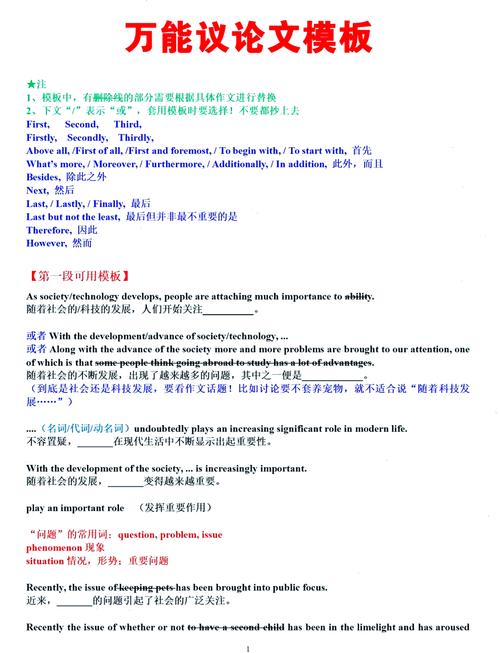 (图片来源网络,侵删)
- 目的:吸引读者,引出话题,明确表明你的论点。
- 构成:
- “钩子”:用一个引人入胜的开头,如一个普遍现象、一个有趣的问题、一个惊人的数据或一句名言。
- 背景信息:简要介绍话题的背景,让读者了解你要讨论的是什么。
- thesis statement (中心论点):清晰地陈述你的观点和立场,这是整篇文章的灵魂。
-
主体段
- 目的:用具体的论据来支持和证明你的中心论点。
- 构成:通常包含2-3个主体段,每一段都应有一个独立的分论点。
- “PEA”结构:每个主体段内部可以遵循这个结构,使论证更严密。
- P - Point (分论点):段落的第一句话,明确提出本段的中心思想。
- E - Explanation (解释):解释你的分论点,阐述它为什么成立。
- A - Argument/Evidence (论据):提供具体的证据来支持你的分论点,证据可以是事实、数据、研究、个人经历、专家观点或具体事例。
- (可选) A - Analysis (分析):进一步分析你的论据如何有力地支持了分论点,并再次扣回中心论点。
-
让步段
- 目的:承认并讨论对立观点,然后进行反驳,这会让你的文章显得更客观、更有说服力,而不是偏激。
- 构成:
- 承认:用 "Admittedly," "It is true that..." 等词语承认对方观点有一定的合理性。
- 转折:用 "however," "nevertheless," "despite this" 等词进行转折。
- 反驳:说明为什么对方观点站不住脚,或者为什么你的观点更优。
-
结论段
- 目的:总结全文,重申论点,并升华主题,给读者留下深刻印象。
- 构成:
- 重申论点:用不同的措辞再次强调你的中心论点,切忌直接复制原文。
- 总结分论点:简要回顾你在主体段中提出的几个主要理由。
- 升华/展望:提出一个引人深思的问题、一个预测、一个建议或一个更广泛的意义,让文章的立意更高。
写作步骤
- 审题:仔细阅读题目,确保完全理解题目的要求,关键词是什么?是需要讨论利弊、分析原因,还是提出解决方案?
- 头脑风暴:花几分钟时间,围绕主题快速写下所有相关的想法、论据、例子和关键词。
- 列提纲:这是最关键的一步,根据你的头脑风暴结果,构建一个清晰的提纲,包括引言段的“钩子”、背景和中心论点,每个主体段的分论点和论据,让步段和结论段的大致内容。
- 撰写初稿:根据提纲进行写作,不要过分担心语法或词汇的完美,先把想法表达出来,保持思路的流畅。
- 修改与润色:
- 论点是否清晰?论据是否充分?逻辑是否连贯?
- 结构:段落安排是否合理?过渡是否自然?
- 语言:检查语法错误、拼写错误,替换重复的词汇,使用更高级、更精准的表达。
- 朗读:大声朗读你的文章,这能帮助你发现不通顺的句子。
常用句型和表达
引言段
- 引出话题:
- In recent years, the issue of... has sparked a heated debate.
- With the rapid development of society, ... has become a prevalent phenomenon.
- There is a growing consensus that...
- 表明立场:
- This essay will argue that...
- From my perspective, I firmly believe that...
- While some people argue that..., I am convinced that...
主体段
- 提出分论点:
- The primary reason for my stance is that...
- Another compelling argument in favor of... is...
- A case in point is...
- 举例/提供证据:
- For instance, / For example,
- To illustrate, / A case in point is...
- According to a recent survey/study by...
- This can be clearly seen in the example of...
让步段
- 承认对方观点:
- Admittedly, / It is true that...
- Opponents of this view claim that...
- While it is undeniable that...
- 进行反驳:
- However, / Nevertheless, / Nonetheless,
- This argument fails to consider the fact that...
- The benefits of... far outweigh the drawbacks.
结论段
- 总结全文:
- In conclusion, / To sum up, / In a nutshell,
- All the arguments above point to the conclusion that...
- Having considered all the evidence, it is safe to conclude that...
- 升华主题:
- It is imperative that we should...
- Only by doing so can we...
- Looking ahead, it is reasonable to predict that...
范文示例
** Some people believe that university education should be free for everyone. To what extent do you agree or disagree?
Free University Education: A Boon or a Burden?
In an era where knowledge is paramount, the question of whether university education should be universally free has become a topic of intense public discourse. While the prospect of accessible higher education is undeniably appealing, I firmly believe that making it entirely free for everyone is neither practical nor sustainable, and a more nuanced approach is required.
The primary argument against universally free university education lies in its immense financial burden on the state. Funding tuition for every aspiring student would require a colossal allocation of public funds, which could otherwise be channeled into crucial sectors such as healthcare, infrastructure, and primary education. For instance, countries with strained public finances might find themselves unable to maintain the quality of their free university systems, leading to overcrowded classrooms, outdated facilities, and a decline in academic standards. This would ultimately defeat the purpose of providing high-quality education.
Furthermore, making university education free for all might devalue its significance and lead to inefficiency. When education is perceived as a commodity with no personal cost, some students might not appreciate the opportunity and could lack the motivation to apply themselves diligently. A case in point can be observed in some European countries with long-standing free tuition systems, where high dropout rates and extended study periods are not uncommon. This not only wastes valuable educational resources but also delays the entry of motivated individuals into the workforce. In contrast, a system where students contribute, even partially, fosters a greater sense of responsibility and commitment.
Admittedly, the prospect of free university education is compelling. It promises to level the playing field, allowing talented individuals from low-income backgrounds to pursue higher education without the shackles of debt. This would undoubtedly promote social mobility and create a more equitable society. However, this goal can be achieved through alternative means, such as needs-based scholarships, grants, and subsidized loans, rather than making it free for everyone, including those from affluent families who can easily afford the fees.
In conclusion, while the ideal of free university education for all is noble, its implementation is fraught with practical and financial challenges. A blanket free system risks overburdening national economies and potentially devaluing the academic experience itself. A more prudent and effective strategy would be to implement targeted financial aid programs that support those who need it most, ensuring both equity and the sustainable quality of higher education.
高分技巧
- 逻辑清晰:确保每个段落都有一个明确的中心思想,并且段落之间有良好的过渡词连接。
- 论据具体:避免使用空泛的词语,用具体的例子、数据或事实来支撑你的观点,这比重复说“我认为...”要有力得多。
- 词汇丰富:使用同义词替换重复的词汇,并尝试使用一些更高级、更精确的学术词汇。
- 句式多样:不要总是使用简单句,交替使用简单句、复合句和复杂句,可以使文章读起来更有节奏感和学术性。
- 观点平衡:通过让步段来展示你的客观性,这会让你的论证显得更全面、更令人信服。
- 紧扣主题:确保你的每一个论点和例子都直接服务于你的中心论点,不要跑题。
希望这份详细的指南能帮助你写出优秀的英语议论文!祝你写作顺利!